How to Draw a Floor Plan by Hand Books
How to Draw a Flooring Program
Don't start decorating without an analysis of your infinite and an authentic floor plan. A floor plan is the easiest way to become a handle on how much space you accept, and what that space'south stiff and weak points are. To create an accurate flooring programme, starting time by measuring a room:
-
Measure forth the baseboard the length of i wall, from 1 corner of the room to another.
For accurateness, measure to the nearest 1/4 inch. Record this number on your crude floor programme and in your notebook.
-
Measure the remaining walls the same way you measured the first.
Near rooms have four walls, but if you're measuring an L-shaped room, yous have more to mensurate. Include every wall in your sketch, especially if y'all plan to give one part of the room a different floor or wall covering.
-
Measure the room'south doorways and other entries.
Note whether the door opens into or out of the room and indicate the direction (with an arc) on your rough floor plan sketch. Also mensurate the distances of all openings — doors and open up archways — from the ends of the walls so that yous can accurately locate these openings on your final program.
-
Determine the size of the windows.
Include the window frame from outside border to exterior border. Record the measurements for whatsoever moldings around the window separately. Gauge the distance from the floor to the bottom of the window frame, from the ceiling to the peak of the window molding, and from the window (on each side) to the corner of the wall (or adjacent window or opening).
-
Measure out any and all architectural features, including fireplaces, brackets, shelves, and whatever other congenital-in features.
Measure surrounding space and outside or overall dimensions of these items, and then locate each on your plan.
-
Measure the walls from side to side and from the floor to the ceiling.
-
Measure out where the electrical outlets, switches, and other controls are located.
Note where heat and air conditioning ducts, radiators, chases (coverings for electrical wires and plumbing pipes), and exposed pipes are located.
After you cease measuring, you lot're ready to draw your floor plan to scale:
-
Lightly pencil in the room's major areas on graph newspaper earlier firmly committing to hard-to-erase night lines.
Include the room's irregularities, such equally support columns or whatever other intrusions.
-
Note on the newspaper the room's directional orientation (north, south, east, and west).
The quantity and quality of natural light affects a number of decisions.
-
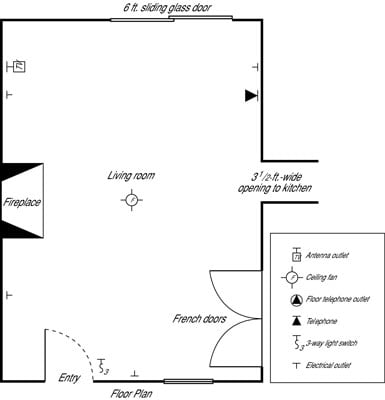
Draw the room's specifics, using a thicker straight line for walls, windows, and fireplaces.
Annotation also the within width of the doors and other openings and then that yous know if your sofa (or other large piece of furniture) tin can fit through the opening, up the stairs, or effectually a turn in the hallway.
-
Indicate where all permanent switches, outlets, controls, TV cable, and telephone lines are located
These factors all influence piece of furniture placement. Don't brand the mistake of putting bookcases in front of the only phone jack in the room, loading upwards all the shelves, and then discovering that you can't plug in your phone!
-
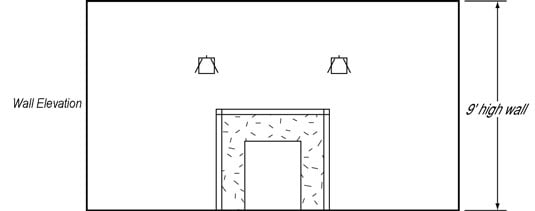
Depict each wall's elevations.
The wall elevations are two-dimensional representations that aid you figure out fine art and accompaniment system or window treatment. Again, remember to marking all the permanent features, such as calorie-free switches, electrical outlets, phone and Television cable jacks, air conditioning and estrus vents, and and so on.
About This Article
This article tin be plant in the category:
- Decorating ,
Source: https://www.dummies.com/article/home-auto-hobbies/home-improvement-appliances/decorating/how-to-draw-a-floor-plan-181755/
0 Response to "How to Draw a Floor Plan by Hand Books"
Publicar un comentario